| Technical Parameter | Specification Details | |
| Material | PA (Polyamide) | |
| Size | 1 Inch Threaded Connection | |
| Connection Type | Kinetic 1″ BSPT | |
| Standard Pressure | PN 10 | |
| Color | Green |

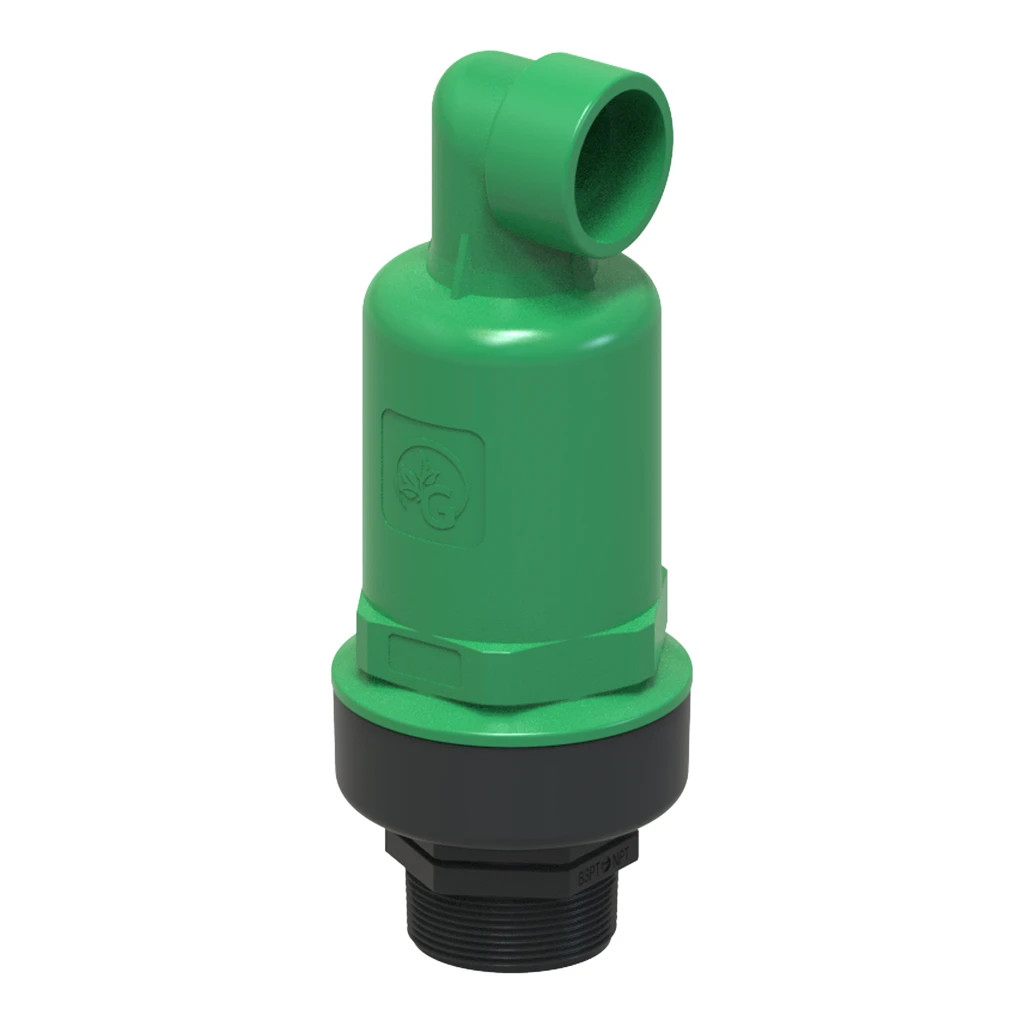
| Technical Parameter | Specification Details | |
| Material | PA (Polyamide) | |
| Size | 1 Inch Threaded Connection | |
| Connection Type | Kinetic 1″ BSPT | |
| Standard Pressure | PN 10 | |
| Color | Green |
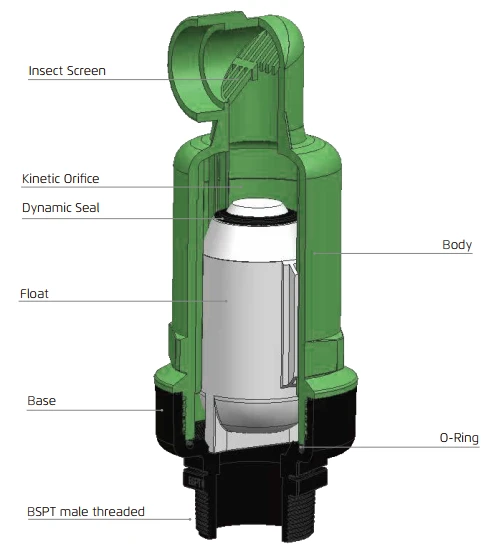
Air Release Valve (ARV) – Irrigation Systems
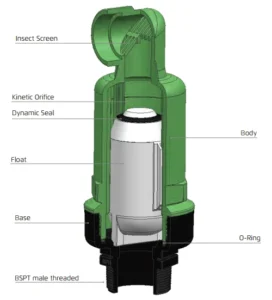
They are designed to efficiently extract air trapped in pipes, filters, tanks, and other places where unwanted air might cause performance problems.
The release valves are located at the outlet of pipes whose slope varies according to the hydraulic gradient, in areas where pipes are located above ground level, in long pipes with uniform slope, at the input of measuring instruments, the output of reducing valves, in diameter reductions, pumps, filtration systems, and on both sides of an underground crossing road.
For correct operation, the valve should always be in a vertical position.
Installing a manual ball valve under the Air Valve is recommended to make maintenance and repair operations easier without shutting the whole system.
This valve automatically expels trapped air from irrigation pipelines during filling, operation, and drainage, preventing airlocks, water hammer, and pressure surges that damage pumps and fittings. Its corrosion-resistant float mechanism seals tightly once water rises, ensuring efficient, uninterrupted flow.
Benefits: Protects pumps and pipe joints, reduces energy consumption, prevents pipe bursts, improves flow consistency in drip and sprinkler systems, and extends system lifespan by minimizing internal corrosion.
Installation: Mount vertically at pipeline high points, after pumps, and at dead ends. Use a threaded riser with an isolation valve for maintenance access. Ensure the outlet remains unobstructed, and flush the line before first use to verify proper float operation.
 Sale!
Sale!